Serving Victoria, TX & nearby Mon–Sat 7am–7pm
Licensed & Insured · Free Estimates

Fiber Cement Siding Installation in Victoria, TX

What actually goes into a proper fiber cement installation, from the moisture barrier underneath to the final caulked joint.

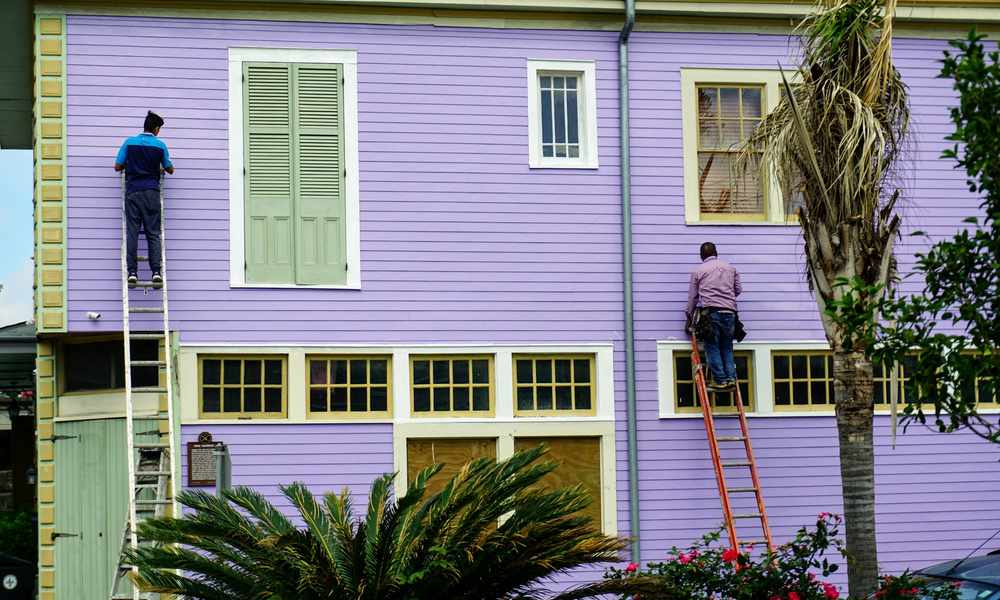
Contractors on ladders working on a home's exterior wall

Fiber cement performs best when it's installed correctly, since the material itself is only half the equation — the flashing and moisture barrier underneath do most of the actual water-shedding work. Here's what goes into a proper fiber cement installation for a Victoria, TX home. For the full material overview, see our fiber cement siding service page.

Typical lap-siding wall assembly at a window head A line drawing showing, from back to front: wall sheathing, a weather-resistant barrier lapped shingle-fashion, and lap siding courses. At the window head, the barrier laps over the flashing above the opening and under the flashing below it, so water sheds down and out rather than behind the wall. Head flashing Moisture barrier Siding
Typical lap-siding wall assembly, illustrative

Step 1: Weather-Resistant Barrier and Flashing

Before any siding goes up, a weather-resistant barrier covers the sheathing, and flashing is installed at every window, door, and penetration. This layer — not the fiber cement itself — is what actually directs water out and away from the wall assembly. Most siding failures trace back to a gap or mistake here, not to the siding material failing on its own.

Step 2: Cutting and Handling

Fiber cement is dense and produces fine dust when cut, so it's scored-and-snapped or cut with a shear or dust-collecting saw rather than a standard blade whenever possible. Boards are handled carefully during transport and staging since the material, while durable once installed, can chip at an edge if mishandled before it's up.

Step 3: Fastening

Fasteners are driven at the manufacturer's specified pattern and depth so the board isn't overdriven or split. Getting this detail right is what keeps boards secure without cracking them — a common mistake with fiber cement is treating it like a softer material and overdriving fasteners.

Step 4: Finish and Caulking

Factory-primed and factory-finished boards arrive with their color already baked on; field-finished boards get primed and painted on site after installation. Either way, joints get caulked with a paintable, flexible sealant rated for exterior use — a detail that's easy to rush and expensive to redo if it's missed or done poorly.

Removal and Disposal of Old Siding

On a full installation over existing siding, the old material typically comes off down to the sheathing first, which is also when the weather-resistant barrier and flashing underneath get inspected and corrected before any new fiber cement goes up. Old siding, packaging, and job-site debris are hauled away as part of the project — a Victoria, TX home shouldn't be left looking like a construction site once the crew leaves.

Installation Questions, Answered

How long does a fiber cement installation take?
Most residential siding replacements are completed in about one to two weeks depending on the size of the home, weather, and how much prep work (removal, sheathing repair) the project needs. We give you a clear timeline before we start.
Can fiber cement be installed in any weather?
Certain steps — painting field-finished boards and applying caulk — need appropriate temperature and dry conditions to cure correctly. We plan around Victoria, TX weather to make sure those steps are done right, not rushed.

Related Resources

Get Your Free Fiber Cement Installation Estimate

Take this quick quiz to determine which siding material fits your home

Three quick questions, then a straight answer about where we'd start the conversation for a Victoria, TX home. Nothing here is a verdict — the free on-site estimate is what decides it.

What matters most to you in new siding?
What's on the house right now?
Where is the project at?
Based on your answers

Durability points toward fiber cement first

Fiber cement holds up to the Victoria, TX sun, moisture, fire, and pests better than most materials, and it holds paint well. Stucco is also worth a look if you like a seamless masonry finish. Either way, how it's installed — flashing and the moisture barrier underneath — matters as much as the material.

Low upkeep points toward vinyl or fiber cement

Vinyl never needs painting, and fiber cement holds paint for years between coats — they keep upkeep low in different ways. Which one fits depends on the house and the look you want, which is exactly what the on-site visit is for.

Upfront cost points toward vinyl first

Vinyl is where most upfront-cost comparisons start: the lowest material cost and the fastest installation of the three we install. Grade matters more than color for how it holds up, so we'll talk through that rather than just the sample chip.

It depends on the look you're after

Fiber cement comes in lap, panel, and shingle profiles; vinyl in clapboard, dutch lap, and board-and-batten; stucco gives a seamless finish with no panel joints at all. Tell us the look and we'll bring the options that actually deliver it to the estimate.

Something else is driving it — tell us what

If it's a mix of these, or something we didn't list, put it in the notes below and we'll start the conversation there. Any of the three materials we install can be the right answer depending on the house — the free on-site estimate is what decides it.

  • Older wood or lap siding is worth checking for rot and moisture behind it before anything new goes on — that's where most siding failures we see actually start.
  • If the existing vinyl is warping, buckling, or loose, it's worth finding out whether that's the panels or what's behind them before choosing a replacement.
  • Existing stucco can often be repaired in sections rather than redone wall by wall, so a repair is worth weighing against a full re-clad.
  • We'll identify what's on the house, and what condition it's in, during the free on-site estimate.
  • Whatever's on the house now, we'll identify it and check its condition during the free on-site estimate — if you know what it is, mention it in the notes below.
  • No pressure either way — the material pages on this site cover how each one is installed and holds up, and we're happy to answer questions before you're ready for a quote.
  • Our quotes are itemized and in writing, so you can compare them line by line with anyone else's.
  • Damage is worth looking at before material choice — the fix has to start with the cause, usually water getting behind the cladding.
  • Send your details below and we'll get right back to you to set up the on-site visit.
  • Wherever you're at with it, there's no pressure — tell us in the notes below and we'll pick up from there.

Get your free on-site estimate

Send your details and we'll follow up with a free, no-pressure on-site estimate for your Victoria, TX home. Your answers above come with it, so we can pick up where this left off.

Prefer to talk now? Call (361) 310-1492.

Get Your Free Fiber Cement Installation Estimate

Call now or request a free quote — most estimates scheduled within 24 hours.